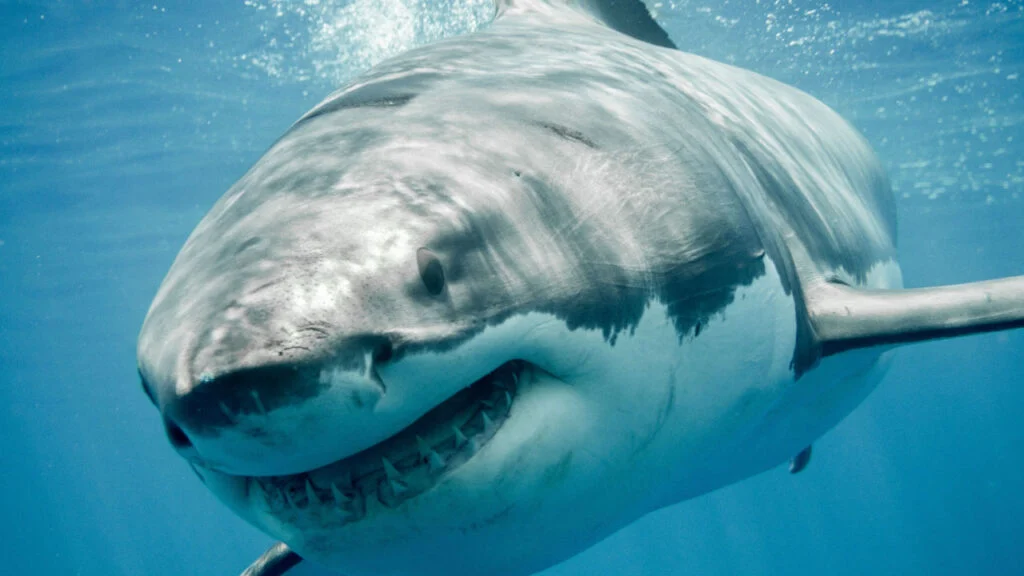
88themovie.com – The great white shark (Carcharodon carcharias), often referred to as the “white shark,” is one of the most fearsome and awe-inspiring predators in the ocean. With its powerful build, razor-sharp teeth, and exceptional hunting skills, the great white has earned a reputation as the king of the sea. Found in coastal and offshore waters around the world, this species plays a vital role in maintaining the health of marine ecosystems as an apex predator.
Physical Characteristics
The great white shark is a large and robust species, with adult individuals typically measuring between 13 to 16 feet in length, though some can grow to over 20 feet. They can weigh up to 5,000 pounds, with females generally being larger than males. Their bodies are torpedo-shaped, streamlined for fast swimming, and built for power and speed.
The coloration of the great white is one of its most defining features. Its dorsal side (back) is gray or blue-gray, which helps it blend in with the dark depths of the ocean when viewed from above, while its ventral side (underbelly) is white, providing camouflage when seen from below against the lighter surface waters. This countershading allows the great white to approach prey stealthily.
Perhaps the most iconic aspect of the great white shark is its large, serrated, triangular teeth. These teeth are designed to shear through flesh and bone, and the shark can lose and regrow thousands of teeth throughout its lifetime. Their jaws are incredibly strong, capable of delivering one of the most powerful bites in the animal kingdom.
Habitat and Range
Great white sharks are widely distributed and can be found in oceans around the world, particularly in temperate coastal waters. They are commonly seen off the coasts of North America (especially California), South Africa, Australia, and parts of the Mediterranean. They prefer areas where the water is between 12 and 24°C (54-75°F), although they can venture into colder or warmer waters.
These sharks are known to migrate great distances, often traveling between feeding grounds and breeding areas. Some populations exhibit seasonal movements, with sharks moving to warmer waters in the winter months and returning to cooler waters in the summer. Recent research has shown that great whites are capable of crossing entire ocean basins, demonstrating their incredible range and adaptability.
Feeding Behavior and Diet
As apex predators, great white sharks are at the top of the marine food chain. They are carnivores, with a diet that consists primarily of marine mammals, such as seals, sea lions, dolphins, and whales. They also feed on fish, including other sharks, rays, and large bony fish, as well as seabirds and carrion (dead animals).
Young great white sharks tend to focus on smaller prey, such as fish and rays, while adults shift to larger, more energy-rich animals like seals and sea lions. Great whites use a combination of stealth and power to catch their prey. They often ambush their targets from below, using their speed and strength to deliver a fatal bite.
Great whites are also known for their impressive breaching behavior. In regions like South Africa, they have been observed launching themselves out of the water in spectacular leaps when attacking prey, particularly seals. This behavior highlights their extraordinary hunting abilities and strength.
Social Structure and Behavior
Great white sharks are generally solitary creatures, though they are sometimes observed in small groups around rich feeding grounds. These interactions are often characterized by dominance hierarchies, where larger sharks take precedence over smaller individuals when feeding.
Despite their solitary nature, great whites display complex behaviors and may engage in social interactions, particularly during mating and feeding. They are also highly intelligent animals, capable of problem-solving and learning from experience.
Great white sharks are known to be curious and will often investigate objects or boats by swimming close and sometimes bumping them with their noses. While they are capable of aggressive behavior, they are not mindless killing machines, as often portrayed in popular culture. Most attacks on humans are believed to be cases of mistaken identity, where the shark mistakes a swimmer or surfer for its natural prey, such as a seal.
Reproduction and Lifespan
Little is known about the reproductive behavior of great white sharks, as much of it occurs in deep waters far from human observation. However, it is believed that they reach sexual maturity between 12 and 15 years of age. Females give birth to live young after a gestation period of about 11 months. Great whites are ovoviviparous, meaning that the eggs hatch inside the mother’s body, and the young sharks are born fully formed and capable of surviving on their own.
Litters typically consist of 2 to 10 pups, each about 4 to 5 feet long at birth. After birth, the young sharks are left to fend for themselves, as there is no parental care in this species. They must quickly learn to hunt and avoid predators, including larger sharks.
Great white sharks are long-lived animals, with a lifespan of 40 to 70 years in the wild. Their slow growth and late maturation make them vulnerable to population declines, as they reproduce relatively infrequently compared to other marine animals.
Conservation Status and Threats
The great white shark is currently listed as “Vulnerable” on the International Union for Conservation of Nature (IUCN) Red List. While they are protected in many parts of the world, great white sharks face several threats, primarily from human activity. Overfishing, bycatch in commercial fishing gear, and habitat destruction all pose risks to their populations.
In some areas, great white sharks are targeted by trophy hunters and illegal fishing operations, despite protective regulations. Shark finning, where sharks are caught and their fins removed for use in shark fin soup, is another significant threat, although great whites are less commonly targeted for this practice than other species.
Climate change also presents a growing challenge, as warming ocean temperatures and shifting ecosystems can affect the availability of prey and disrupt shark migration patterns.
Despite these challenges, conservation efforts are underway to protect great white sharks. Many countries have established shark sanctuaries, marine protected areas, and fishing regulations aimed at reducing human impact on shark populations. Public education and ecotourism, particularly shark cage diving, have also helped to change perceptions of these animals, highlighting their importance to ocean ecosystems.
Importance to Marine Ecosystems
As apex predators, great white sharks play a crucial role in maintaining the balance of marine ecosystems. By controlling populations of prey species, such as seals and large fish, they help prevent overpopulation and maintain the health of the ocean’s food web. Their presence can also have a “top-down” effect on other species, shaping the behavior and distribution of marine animals.
The loss of great white sharks from an ecosystem can lead to imbalances, causing ripple effects throughout the food chain. This makes their conservation not only important for the species itself but also for the overall health and stability of marine environments.
Conclusion
The great white shark is one of the most iconic and misunderstood predators in the animal kingdom. Despite its fearsome reputation, it is a vital part of ocean ecosystems and plays a key role in maintaining the health of marine life. While the species faces significant challenges from human activity and environmental changes, ongoing conservation efforts provide hope for the continued survival of this apex predator. By protecting great white sharks and their habitats, we ensure that these magnificent creatures remain an essential part of the ocean’s natural balance for generations to come.